Reporting and Writing
Throughout my time on the ReMarker, I had the opportunity to report on fascinating story topics. From profiles to issue-driven features, my work has covered various themes.
Stressed Students Abuse Stimulants
Investigative feature | Health reporting
I pursued this story because stimulant misuse was an open secret on campus. Everyone knew it existed, but no one talked about it honestly. Students framed it as harmless, a shortcut, not a risk. I wanted to understand why that narrative felt so normal and what consequences were being ignored.
Reporting required balancing confidentiality with credibility. Many sources were willing to speak only anonymously, which forced me to double and triple-confirm every claim with medical professionals and published research. The most difficult challenge was avoiding sensationalism. It would have been easy to dramatize the issue, but exaggeration would undermine trust. I chose a restrained tone that centered evidence and lived experience.
After publication, the conversation around study drug use shifted from jokes to concern. Teachers and students began discussing pressure and workload more openly. If I revisited this piece, I would push further into long-term solutions rather than stopping at diagnosis. This story taught me that responsible journalism questions the culture that makes that behavior feel acceptable.
Impact: Sparked classroom discussions about stimulant misuse
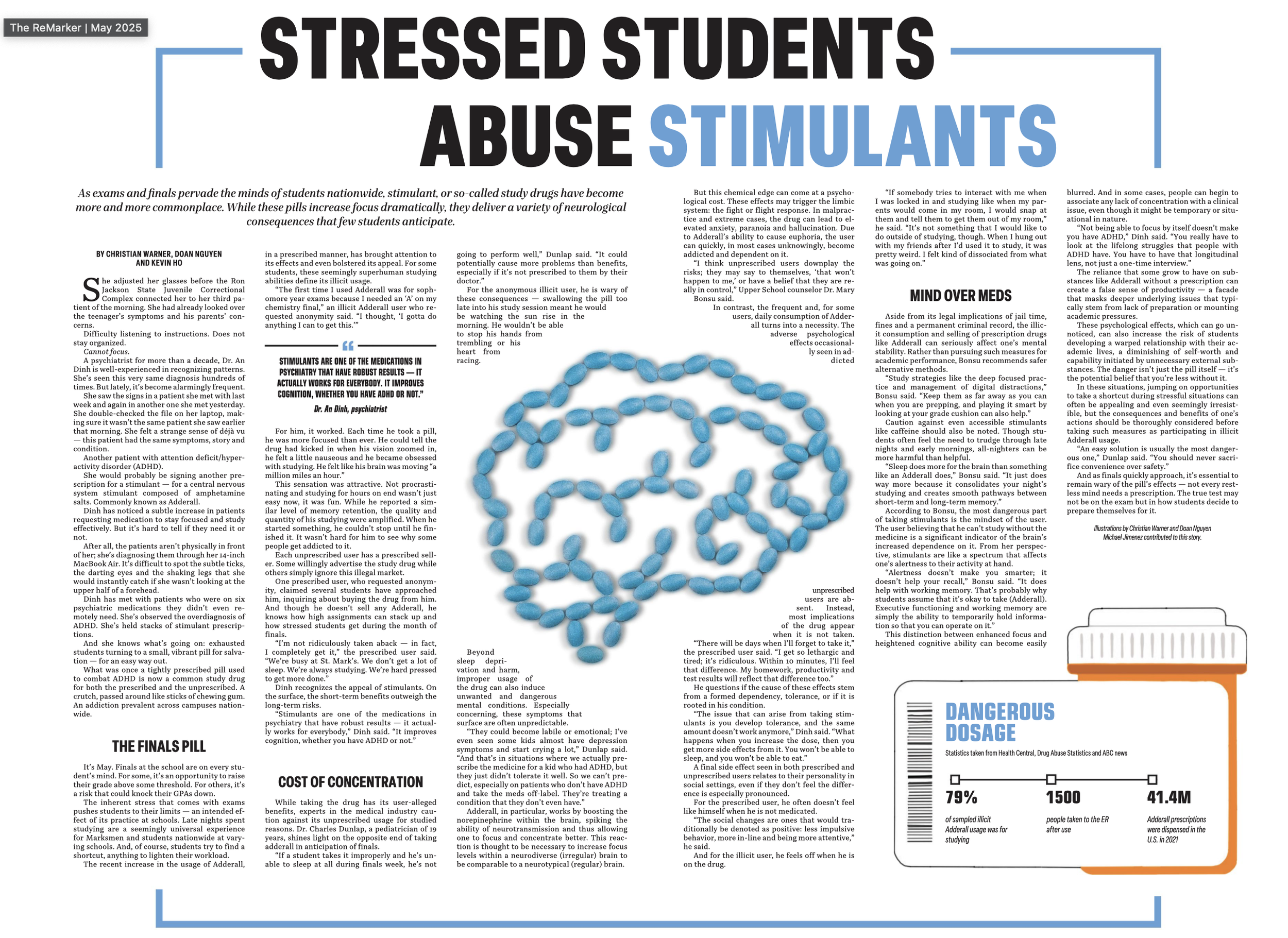
She adjusted her glasses before the Ron Jackson State Juvenile Correctional Complex connected her to her third patient of the morning. She had already looked over the teenager’s symptoms and his parents' concerns.
Difficulty listening to instructions. Does not stay organized.
Cannot focus.
A psychiatrist for more than a decade, Dr. An Dinh is well-experienced in recognizing patterns. She’s seen this very same diagnosis hundreds of times. But lately, it’s become alarmingly frequent.
She saw the signs in a patient she met with last week and again in another one she met yesterday. She double-checked the file on her laptop, making sure it wasn’t the same patient she saw earlier that morning. She felt a strange sense of déjà vu — this patient had the same symptoms, story and condition.
Another patient with attention deficit/hyperactivity disorder (ADHD).
She would probably be signing another prescription for a stimulant — for a central nervous system stimulant composed of amphetamine salts. Commonly known as Adderall.
Dinh has noticed a subtle increase in patients requesting medication to stay focused and study effectively. But it’s hard to tell if they need it or not.
After all, the patients aren’t physically in front of her; she’s diagnosing them through her 14-inch MacBook Air. It’s difficult to spot the subtle ticks, the darting eyes and the shaking legs that she would instantly catch if she wasn’t looking at the upper half of a forehead.
Dinh has met with patients who were on six psychiatric medications they didn’t even remotely need. She’s observed the overdiagnosis of ADHD. She’s held stacks of stimulant prescriptions.
And she knows what’s going on: exhausted students turning to a small, vibrant pill for salvation — for an easy way out.
What was once a tightly prescribed pill used to combat ADHD is now a common study drug for both the prescribed and the unprescribed. A crutch, passed around like sticks of chewing gum. An addiction prevalent across campuses nationwide.
THE FINALS PILL
It’s May. Finals at the school are on every student’s mind. For some, it’s an opportunity to raise their grade above some threshold. For others, it’s a risk that could knock their GPAs down.
The inherent stress that comes with exams pushes students to their limits — an intended effect of its practice at schools. Late nights spent studying are a seemingly universal experience for Marksmen and students nationwide at varying schools. And, of course, students try to find a shortcut, anything to make their workload lighter.
The recent increase in the usage of Adderall, in a prescribed manner, has brought attention to its effects and even bolstered its appeal. For some students, these seemingly superhuman studying abilities define its illicit usage.
“The first time I used Adderall was for sophomore year exams because I needed an ‘A’ on my chemistry final,” an illicit Adderall user who requested anonymity said. “I thought, ‘I gotta do anything I can to get this.’”
For him, it worked. Each time he took a pill, he was more focused than ever. He could tell the drug had kicked in when his vision zoomed in, he felt a little nauseous and he became obsessed with studying. He felt like his brain was moving “a million miles an hour.”
This sensation was attractive. Not procrastinating and studying for hours on end wasn’t just easy now, it was fun. While he reported a similar level of memory retention, the quality and quantity of his studying were amplified. When he started something, he couldn’t stop until he finished it. It wasn’t hard for him to see why some people get addicted to it.
Each unprescribed user has a prescribed seller. Some willingly advertise the study drug while others simply ignore this illegal market.
One prescribed user, who requested anonymity, claimed several students have approached him, inquiring about buying the drug from him. And though he doesn’t sell any Adderall, he knows how high assignments can stack up and how stressed students get during the month of finals.
“I’m not ridiculously taken aback — in fact, I completely get it,” the prescribed user said. “We’re busy at St. Mark’s. We don’t get a lot of sleep. We’re always studying. We’re hard pressed to get more done.”
Dinh recognizes the appeal of stimulants. On the surface, the short-term benefits outweigh the long-term risks.
“Stimulants are one of the medications in psychiatry that have robust results — it actually works for everybody,” Dinh said. “It improves cognition, whether you have ADHD or not.”
COST OF CONCENTRATION
While taking the drug has its user-alleged benefits, experts in the medical industry caution against its unprescribed usage for studied reasons. Dr. Charles Dunlap, a pediatrician of 19 years, shines light on the opposite end of taking adderall in anticipation of finals.
“If a student takes it improperly and he’s unable to sleep at all during finals week, he’s not going to perform well,” Dunlap said. “It could potentially cause more problems than benefits, especially if it’s not prescribed to them by their doctor.”
For the anonymous illicit user, he is wary of these consequences — swallowing the pill too late into his study session meant he would be watching the sun rise in the morning. He wouldn’t be able to stop his hands from trembling or his heart from racing.
Beyond sleep deprivation and harm, improper usage of the drug can also induce unwanted and dangerous mental conditions. Especially concerning, these symptoms that surface are often unpredictable.
“They could become labile or emotional; I’ve even seen some kids almost have depression symptoms and start crying a lot,” Dunlap said. “And that’s in situations where we actually prescribe the medicine for a kid who had ADHD, but they just didn’t tolerate it well. So we can’t predict, especially on patients who don’t have ADHD and take the meds off-label. They’re treating a condition that they don’t even have.”
Adderall, in particular, works by boosting the norepinephrine within the brain, spiking the ability of neurotransmission and thus allowing one to focus and concentrate better. This reaction is thought to be necessary to increase focus levels within a neurodiverse (irregular) brain to be comparable to a neurotypical (regular) brain.
But this chemical edge can come at a psychological cost. These effects may trigger the limbic system: the fight or flight response. In malpractice and extreme cases, the drug can lead to elevated anxiety, paranoia and hallucination. Due to Adderall’s ability to cause euphoria, the user can quickly, in most cases unknowingly, become addicted and dependent on it.
“I think unprescribed users downplay the risks; they may say to themselves, ‘that won’t happen to me,’ or have a belief that they are really in control,” Upper School counselor Dr. Mary Bonsu said.
In contrast, the frequent and, for some users, daily consumption of Adderall turns into a necessity. The adverse psychological effects occasionally seen in addicted unprescribed users are absent. Instead, most implications of the drug appear when it is not taken.
“There will be days when I’ll forget to take it,” the prescribed user said. “I get so lethargic and tired; it’s ridiculous. Within 10 minutes, I’ll feel that difference. My homework, productivity and test results will reflect that difference too.”
He questions the cause of these effects, wondering if they stem from a formed dependency or tolerance or if it is rooted in his condition.
“The issue that can arise from taking stimulants is you develop tolerance, and the same amount doesn’t work anymore,” Dinh said. “What happens when you increase the dose, then you get more side effects from it. You won’t be able to sleep, and you won’t be able to eat.”
A final side effect seen in both prescribed and unprescribed users relates to their personality in social settings, even if they don’t feel the difference is especially pronounced.
For the prescribed user, he often doesn’t feel like himself when he is not medicated.
“The social changes are ones that would traditionally be denoted as positive: less impulsive behavior, more in-line and being more attentive,” he said.
And for the illicit user, he feels off when he is on the drug.
“If somebody tries to interact with me when I was locked in and studying like when my parents would come in my room, I would snap at them and tell them to get them out of my room,” he said. “It’s not something that I would like to do outside of studying, though. When I hung out with my friends after I’d used it to study, it was pretty weird. I felt kind of dissociated from what was going on.”
MIND OVER MEDS
Aside from its legal implications of jail time, fines and a permanent criminal record, the illicit consumption and selling of prescription drugs like Adderall can seriously affect one’s mental stability. Rather than pursuing such measures for academic performance, Bonsu recommends safer alternative methods.
“Study strategies like the deep focused practice and management of digital distractions,” Bonsu said. “Keep them as far away as you can when you are prepping, and playing it smart by looking at your grade cushion can also help.”
Caution against even accessible stimulants like caffeine should also be noted. Though students often feel the need to trudge through late nights and early mornings, all-nighters can be more harmful than helpful.
“Sleep does more for the brain than something like an Adderall does,” Bonsu said. “It just does way more because it consolidates your night’s studying and creates smooth pathways between short-term and long-term memory.”
According to Bonsu, the most dangerous part of taking stimulants is the mindset of the user. The user believing that he can’t study without the medicine is a significant indicator of the brain’s increased dependence on it. From her perspective, stimulants are like a spectrum that affects one’s alertness to their activity at hand.
“Alertness doesn’t make you smarter; it doesn’t help your recall,” Bonsu said. “It does help with working memory. That’s probably why students assume that it’s okay to take (Adderall). Executive functioning and working memory are simply the ability to temporarily hold information so that you can operate on it.”
This distinction between enhanced focus and heightened cognitive ability can become easily blurred. And in some cases, people can begin to associate any lack of concentration with a clinical issue, even though it might be temporary or situational in nature.
“Not being able to focus by itself doesn’t make you have ADHD,” Dinh said. “You really have to look at the lifelong struggles that people with ADHD have. You have to have that longitudinal lens, not just a one-time interview.”
The reliance that some grow to have on substances like Adderall without a prescription can create a false sense of productivity — a facade that masks deeper underlying issues that typically stem from lack of preparation or mounting academic pressures.
These psychological effects, which can go unnoticed, can also increase the risk of students developing a warped relationship with their academic lives, a diminishing of self-worth and capability initiated by unnecessary external substances. The danger isn’t just the pill itself — it’s the potential belief that you’re less without it.
In these situations, jumping on opportunities to take a shortcut during stressful situations can often be appealing and even seemingly irresistible, but the consequences and benefits of one’s actions should be thoroughly considered before taking such measures as participating in illicit Adderall usage.
“An easy solution is usually the most dangerous one,” Dunlap said. “You should never sacrifice convenience over safety.”
And as finals quickly approach, it’s essential to remain wary of the pill’s effects — not every restless mind needs a prescription. The true test may not be on the exam but in how students decide to prepare themselves for it.
Taking an Academic Shortcut Undermines Basic Values
Ethics & accountability reporting
This story came from frustration. Cheating wasn’t rare or shocking; it was routine. What interested me wasn’t the act itself but how casually it was justified. I wanted to explore the gap between the school’s stated values and the private decisions students made under pressure.
The reporting challenge was honesty. Students spoke more freely under anonymity, but anonymity raises skepticism. Every quote had to represent a real sentiment without becoming caricature. The story works only if readers recognize themselves in it. I structured the piece around voices instead of accusations so the argument emerged naturally.
The response was uncomfortable but necessary. Students debated the piece in class. Some felt exposed; others felt relieved that someone said what they had been thinking. If I revisited it now, I would include more faculty voices to complicate the picture. This piece reinforced that journalism is about creating space for difficult conversations.
Impact: Prompted debate about academic integrity policies
At its most basic level, cheating seems easy to define. Cheating is breaking the rules. It could be bringing a phone into a test. Sending your homework to your friends for them to copy. Pretending to yawn in order to sneak a peek at the sheet from the person next to you.
As long as there has been required schooling, academic dishonesty has existed. Walking down the hallways, it’s not uncommon to overhear a conversation consisting of a ‘what was on the test?’ and a ‘was there a reading quiz?”
Some students rarely describe what they’re doing as cheating, instead describing it as problem-solving. Working smarter, not harder.
That shift didn’t happen overnight. J.J. Connolly Master Teaching Chair Nancy Marmion points out that cheating has always existed, but the ease of it has changed. Before the age of the internet, some cheating methods included bringing a cheat sheet into an exam and or writing answers on hands.
“With the internet, with tools like ChatGPT, it’s so easy to cheat, and in turn, so much more tempting,” Marmion said. “It also limits the amount of time you have to think about whether or not you should be cheating.”
In the language department, students are allowed to use the online dictionary ‘Wordreference.com,’ but not translation programs. The distinction starts off clear, but then looking up a word turns into translating a phrase.
“Before you know it, you’ve typed in an entire paragraph, and then your entire paper,” Marmion said.
As the faculty chair of the school’s Discipline Council, Marmion has seen how students justify themselves. In some ways, cheating has become less about dishonesty and more about coping.
“Some of (the students) the Discipline Council meets with do feel guilty,” Marmion said. “But others probably just are sorry because they got caught.”
St. Mark’s is a college-preparatory school — the workload students deal with is substantial. Students juggle demanding classes, athletics, leadership roles, all while feeling pressure to present a flawless version of themselves. To stay afloat in this academically stressful environment, students think they need perfect GPAs, perfect extracurriculars and a perfect SAT score. After all, the final goal is to get into their dream college. In that mindset, lying and cheating can start to feel justified and necessary.
“Some do whatever it takes to get into that school,” Marmion said. “They believe that the ends justify the means. But if you cheat your way into your dream school, you’re not going to be prepared when you get there.”
When a student cheats, he doesn’t just compromise himself. The student on his right, who could’ve studied for hours last night doesn’t get the curve he needed. The teacher, who already suspects the cheater, needs to find other methods to assess students.
“What’s the value of the St. Mark’s diploma?” Marmion said. “Cheating hurts the actual cheater, current students, alumni, future students and ultimately, the institution as a whole.”
At an alumni gathering, one of Marmion’s former students spoke to her about his altered procedure in his writing classes. Every time he writes an essay, he runs it through an AI checker. It’s not like he used AI; he's just spent too much time on it to get accused. Occasionally, the scans flag a couple of phrases and sentences, and he rewrites them so there’s no uncertainty when his teacher grades his work.
“It’s so sad that a student who’s not using AI has to go through all that,” Marmion said. “I don’t know how schools are going to deal with this.”
Thomas B. Walker III ’73 Mathematics Department Chair Shane May remembers when he was taking calculus as a senior in high school, and during an important test, his classmate in front of him turned around and tried to copy a couple of answers.
“I remember being offended and thinking, ‘Why would you think I’d help you right now?” May said.
When May was in high school, there was no internet. No way to take pictures of tests. No way to cheat besides through word of mouth. For him, it’s easy to look back and know that he didn’t cheat on anything. But if he were born and became a student in the age of technology, May doesn’t know how tempted he would be to cheat. Today, even he admits he sometimes uses shortcuts.
“If I want to find some factors of a large number, rather than sit for four or five minutes hunting for a factor, it’s easy to go to Wolfram Alpha and have it find a factor for me,” May said. “To me, that’s not cheating because I know how to find this factor — I’m just trying to save four minutes of my life.”
When dealing with a dishonest student, May hears various types of explanations.
“After catching a student cheating, they could say, ‘You just don’t understand what I’m going through’ or ‘You don’t understand how busy we are,” May said. “Yes, we’re at different places in life, but I’ve had stressful times, too.”
May recognizes that students are under pressure to perform, so before tests, he takes away some of the things that would make it easy to cheat, like phones and uncleared calculators.
He and Marmion know students will stumble and make mistakes. Everyone makes mistakes and, hopefully, learns from them. They don’t hold grudges against students who have cheated in the past, as long as they feel guilty and use the experience to become a better person in the long run.
“As a school, our goal is to help boys become good men,” Marmion said. “The consequences of cheating in high school are very small compared to the consequences of doing something illegal as an adult.”
Beyond the classrooms on campus, cheating extends beyond an isolated academic framework.
The conversation around character at school has expanded over the past two decades, increasing emphasis on bringing the culture of character development from the background to the forefront.
“The desire was for more consistency, clarity and intentionality of purpose,” Eugene McDermott Headmaster David Dini said. “A big part of what we’ve tried to do is to think carefully and intentionally about our mission and make sure we’re devoting the same level of effort and intentionality to character that we do to content.”
But early on, the initiative faced pushback. Some faculty questioned whether it would distract from core academic programs — diminishing the strength of the school.
“Resistance to the idea was like, ‘Now you’re asking me to do something I wasn’t hired to do,’ or ‘You’re asking me to focus on something when my focus is teaching my discipline,’” Dini said.
The administration found its answer through patience. Engaging Marksmen and faculty members, one discussion at a time, building pockets of momentum rather than forcing an immediate schoolwide overhaul.
And over time, those pockets grew. Deterrence of cheating through character — what once lived in the margins of the school’s education — has become central to its identity.
“It’s like learning a language,” Dini said. “You practice it, you do it more frequently. It becomes second nature. So if something happens and you’re in a stress situation, your cognitive experience kicks in. ‘I’ve seen this before. I’ve felt this before. I’m going to be less inclined to make a bad decision.’”
But still, this system doesn’t guarantee total buy-in. The language is taught and incorporated in lessons and activities on campus. But not every student becomes fluent.
“You can easily get in the condition of thinking, ‘If everybody’s going to cheat, everybody’s going to cut a corner, so I can too,’” Dini said.
And when this rationale takes hold, deeper conversations become necessary.
“Usually what occurs is that people have gotten in trouble more than once, and it is upon being caught a second time,” Upper School Counselor Mary Bonsu said. “That’s when we process the stress, the psychology of being a student of integrity and the uncertainty of all of the possible consequences that come with it.”
The bigger issue, she believes, boils down to a lack of tools. Strategies for managing anxiety. Ways to keep perspective when the stakes feel impossibly high. Because everybody messes up. Falls short of their own personal standards. It’s just how they handle their next move.
The pressure to perform well doesn’t create dishonesty on its own, but it does present the temptation to cheat more clearly — a weight that might grow as people get older and involve themselves in a variety of avenues in life beyond the classroom habits formed in one’s youth.
To her, adolescence is a unique time where people are ego-driven. Obsession with image, with status, with getting ahead. And while that doesn’t necessarily mean most kids aren’t going to outgrow these tendencies, not actively working on them can make the patterns developed from youth carry over.
“We do see adults who continue to cheat in many areas,” Bonsu said. “You can see it in people who don’t really hold stable relationships, don’t have a lot of empathy and justify a lot of their negative decisions.”
Because later in life, the arena has shifted. In high school, it’s grades and extracurricular activities. In adulthood, it’s more human connections. Careers. More opportunities for displaying integrity in the moments nobody else is watching.
And for Bonsu, ensuring that students cultivate behaviors to take the high road in their endeavors involves helping them recalibrate what’s actually on the line — beyond the next test or next application cycle, but across a lifetime.
“I think the stakes are sometimes too high,” Bonsu said. “Kids need toolsets to ask themselves, ‘If I don’t get this, or if my life doesn’t go in this direction, will I still be okay? Happy? Content? Proud?’ Those are the outcomes that matter.”
Because in her eyes, what defines fulfillment in life isn’t solely status or high marks or which company someone got hired into. Ultimately, the baseline is character. All built upon a preexisting track record of holding integrity.
“I would love for kids to see the full value of integrity throughout their entire lifespan,” Bonsu said. “If you make great choices and hold integrity high as a young person, then you can have a good level of confidence that you’re going to make moral, high-character decisions when consequences carry more weight.”
And at the core is self-perception. It’s accountability. Conviction.
“Accountability is tied to identity, like, ‘This is who I am.’ You start to inform who you are by how you’re held accountable throughout your entire childhood,” Bonsu said. “And then by 16, 17, you’re like, ‘This is who I am. I’m this kind of person. I can truly look at myself in the mirror.’”
From Moment to Movement
Trauma-informed human feature
This feature began with a single speech, but it became a story about grief, memory, and community. Interviewing Wyatt required patience. Trauma heavily affects memory, and I didn’t want to exaggerate emotion for effect. The challenge was letting silence exist inside the story without trying to explain it away.
I chose to write the piece with minimal quoting. Wyatt’s experience carried the weight; my job was to mold it into words. Every structural decision, pacing, paragraph breaks, transitions, aimed to preserve the intimacy of the conversation. I avoided statistics until the end so readers met the person before the cause.
The impact was visible in the way students responded. Many reached out to share their own experiences with loss. If I returned to this piece today, I would spend more time documenting the ripple effects after publication. This story taught me that journalism can honor vulnerability without exploiting it when the reporter is willing to listen longer than they speak.
Impact: Students shared personal experiences with grief
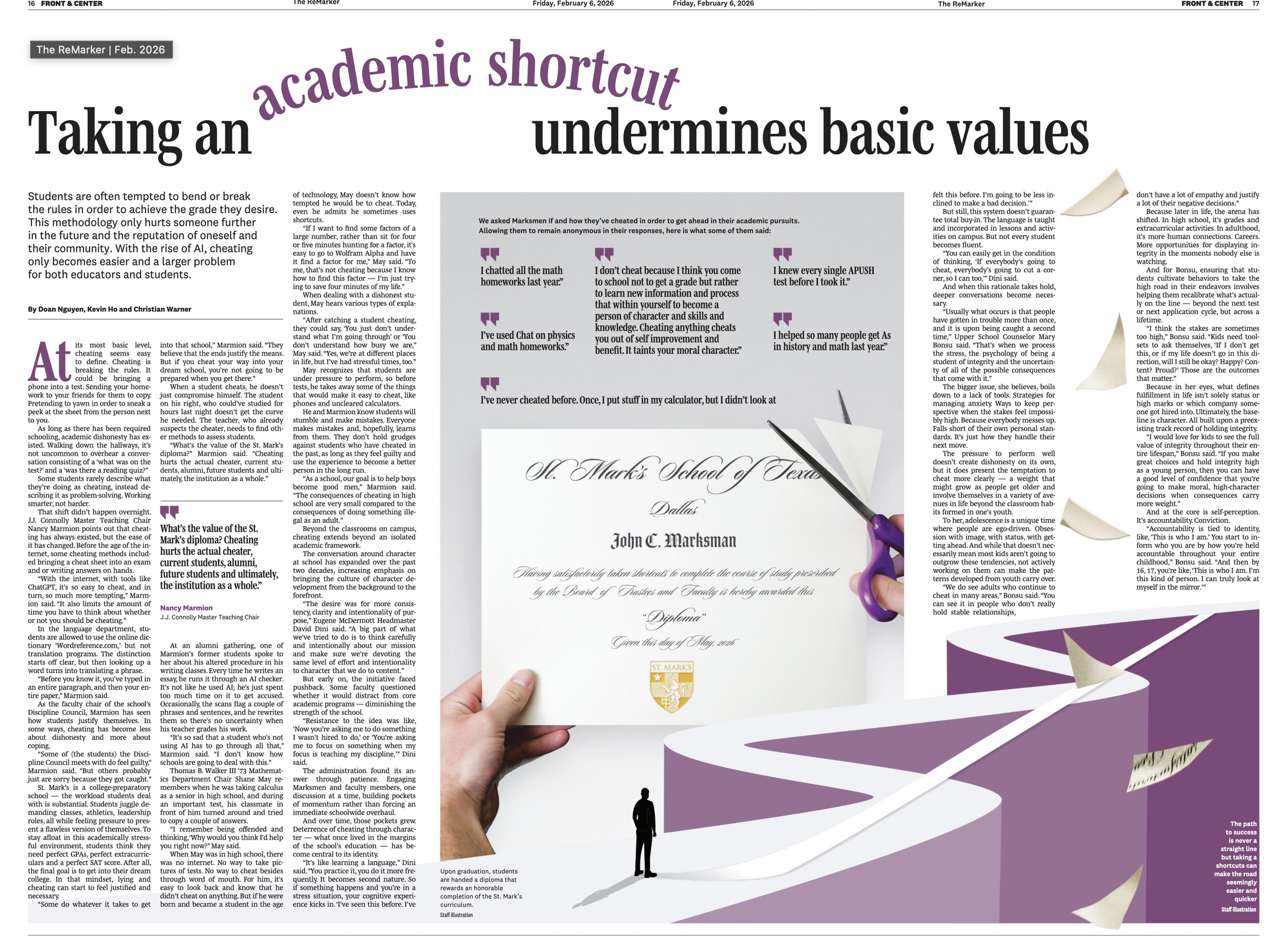
There’s a time in most people’s lives when a single moment — one catalytic event — permanently alters their persona. A rapid change of emotions. A monumental shift in mindset. A new appreciation for the past.
For senior Wyatt Loehr, he was only 3 years old when his moment happened.
He was in that cold, sterile, almost lifeless hospital, visiting his mother. She was infirm at that time and couldn’t even communicate with her young boy. Just a few days later, like 40,000 other women each year, his mother passed away from breast cancer.
In that moment, he lost out on support that would last a lifetime. He never had those cherished, yet often unappreciated, memories other kids have: having her console him as he wept; enjoying the car ride home from school as she constantly probed at every detail of the day; her calming presence when the family dog died; or simply her putting on a band-aid for him with the soft and unmistakable touch of a mother’s love.
Instead, Loehr had to struggle by himself, spending an hour crying in the bathroom, trying to figure out how to put on a band-aid after he ran over his finger while picking up an acorn from his scooter.
Instead, he didn’t have his mother to help his family deal with the loss. Rather, he took responsibility. He would take his little brother Oliver and older sister Teagan into the master bedroom, putting something on the TV to ignore the severity of their grief.
Moments like this defined his childhood, one far more independent than others’, and marked a turning point in his life. But the way Wyatt responded, channeling his pain into a lifetime of inspiring movement forward in his communities, exhibits a dedication to fulfilling his mother’s hopes for him.
Fast forward to 2022, his sophomore year. In his pocket, he felt the familiar buzz of a text message. The message was from a close classmate who had just lost his father. It read: Does it ever stop hurting?
“It doesn’t really stop; there’s always a hole there,” Wyatt replied.
According to Wyatt, though, this hole is hard to define with the lack of definite memories. Since she passed when he was at a young age, he never had a clear image of her from his own experiences.
Everything he knows about her personality is through old stories told by her friends and family. So, as he walks by the main hallway of his house, he sees this one picture of her — his image of her. He imagines her as a guiding voice in his head, asking him to do the right thing. In chapel service, when students are told to pray for those in their hearts, he prays and thinks of his mother. Her presence in his mind pushes him to be better.
His quest for self-improvement, guided by what he knows his mother would want him to do, led Wyatt to the big stage in Decherd Auditorium.
Whenever Wyatt would listen to a great public speaker, he always imagined himself standing up behind the podium, staring out into a crowd that was listening to every word he said. He wanted to be like them — annunciating every word he spoke while conveying a powerful message to a packed audience.
Wyatt had his first big chance with his SuperFanMen role. As one of the student body hype men, he speaks in front of the Upper School each Friday during assemblies. However, his remarks are focused on athletic endeavors and accomplishments, not the robust words he had dreamt of.
During the month of October, however, the school, like many of those across the country, participates in breast cancer awareness month. Each year, the Student Council has an Upper School assembly related to cancer, and the Student Council decided to look for a student to talk to instead of an outside source like a doctor.
When Wyatt was presented with the opportunity to give a This I Believe talk at an Upper School assembly, he immediately pursued it. After talking with fellow Student Council members, he was chosen as the speaker.
At first, when writing the speech, he didn’t know what he wanted to focus on. With so much to cover at a meaningful time during the school year, he knew he had to emphasize just one or two things.
After a long process of writing and refining, Wyatt felt ready and had a clear message defined. Rather than focusing on the numbers or research, he decided to focus on the abstract and unquantifiable — the importance of community in hard times.
According to Wyatt, when at St. Mark’s, where the size of the entire school is comparable to the size of a single grade in other public schools, deep connections and strong relationships can be formed among students, forming the unique culture of the institution.
“St. Mark’s is the perfect storm,” Wyatt said. “There’s enough people to find a friend group, but it’s small enough that you’re on a personally connected level with everyone. When something tragic happens, everyone in the school is there to comfort you.”
Even the campus itself is geared towards enhancing this feeling of belonging and acceptance, with interactions that facilitate having genuine conversations and seizing expansive opportunities being encouraged by 10600’s layout.
“Every aspect of St. Mark’s is catered to creating a strong community,” Wyatt said. “The way the campus is designed, there’s a central space to play games that everyone can see. I’ve had days where I don’t really know what to do, but I’ll see, for example, some underclassmen playing spike ball on the quad, and I’ll go there and make new friends. The sense of community is so strong, it’s a wave that keeps rippling through every class that comes in and keeps getting spread.”
As Wyatt said in his talk, the ripple effect of his mother’s loss affected him and his family immensely.
But the care he received from those around him made it easier to deal with.
“When I was a child and going through it, the support was a huge thing,” Wyatt said. “That’s really the point of this talk.”
For Wyatt’s sophomore brother Oliver, growing up without a mother means he never experienced that care that so many take for granted. He never experienced coming out of a gruesome battle on the wrestling mat, only to look into the stands to see his mom beaming with pride in a way only a mother can, lightening the pain of a narrow defeat.
But what he did see in those stands, what he came home to after an exhausting day at school, what helped him through the highs of championships and the lows of season-ending injuries, was his community.
“I was in a slump during this one big wrestling tournament, and I was 0-2,” Oliver said. “I lost both of them at the last second, and I cried in the locker room. But Teddy Fleiss was there for me, and he helped me get out of my slump and keep trying. Teammates, coaches — they definitely help me when I’m low.”
But the hard part isn’t just receiving care. According to Oliver, what makes a community a community is reciprocating that care. It’s easy to be comforted by someone after a tough loss or a sudden breakup. The challenging job, the duty that everyone owes to their communities, is realizing the suffering of others and responding to it.
“I remember going to get a midnight snack and seeing my dad crying in the living room,” Oliver said. “That’s when I realized everything that was on him and how hard it was being a single father. I had to try harder. I had to do something for him.”
Wyatt and Oliver found that these struggles often were hidden behind forced smiles and passive responses that dismissed the deeper issue. The two found that talking with classmates, however, was a first step to unpacking these emotions and opening up.
“You don’t really want to talk to your own family about your challenges because, in truth, you want to seem strong,” Oliver said. “You don’t want to make it any harder on them because your parents are also going through it at the same time. That’s why friends are really nice: you can talk to them, and they can help you through issues. It’s really important to have good friends who can help you through hard times.”
Being open about feelings and exposing troubles and concerns can help not just the person going through them but those around them struggling with similar issues. That’s the spirit of community — if one person struggles, everyone struggles. And when one person thrives, everyone thrives.
This care came full circle for the pink-out football game on Oct. 18 vs. Southwest Preparatory Conference opponent St. John’s. A week after Wyatt’s talk, the community rallied together to sell out the pink shirts sold in the student store. All of the proceeds were donated to Susan G. Komen, a breast cancer foundation.
On that Friday, students who purchased a shirt wore them to school, showing support for the movement and women on campus.
Under the blinding lights of the football field, the football team geared up in pink attire — bicep bands, turf tape, ankle tape, wristbands and undershirts — as they took the field.
According to Varsity Football Coach Harry Flaherty, the Pink-Out is a great opportunity to show support for those who have suffered from breast cancer. To him, any time people can not only raise awareness but remind themselves and others that there is more to life than competition is a good thing.
Beyond the field, the students packed the student section, making a wall of pink. With an energetic student section led by Wyatt’s fellow SuperFanMen, appreciation for something bigger than the game could be felt.
All of these events — whether under the harsh lights of the Norma and Lamar Hunt Stadium or right above the upholstered seats of the Decherd Auditorium — are shining examples of one thing: community.
And as Wyatt said in his speech, the support of those around him is what made him get through his loss. He didn’t have to face his challenges alone — a sentiment his brother echoes.
“The assembly and the pink-out football game had a very potent effect on campus,” Oliver said. “People know it’s not going to get rid of breast cancer, but it helps me and others realize we’re not alone in this struggle. It is a struggle, but it’s a united one.”
Cultural Shift Encourages a Surge in Apathy
Cultural analysis
I pursued this story because apathy is harder to report than outrage. It’s quiet, internal, and easy to dismiss as laziness. I wanted to understand how social media culture might be reshaping emotional responses rather than simply blaming teenagers.
The challenge was abstraction. Cultural reporting risks becoming vague or preachy. I grounded the piece in individual voices and expert context so the argument stayed anchored in real experiences. Structurally, I treated the story like a conversation, moving between student perspectives and psychological analysis to show tension instead of delivering a single conclusion.
Readers responded by debating whether the trend described them or their peers. That disagreement was the point. If I revisited the piece, I would include more counterarguments to sharpen the discussion. This story reminded me that journalism doesn’t always resolve questions; sometimes its role is to articulate a discomfort people already feel but haven’t named.
Impact: Raised conversations about social isolation
On Aug. 22, Iryna Zarutska, a 23-year-old Ukrainian refugee, was fatally stabbed on a light-rail train in Charlotte, North Carolina. The gruesome video revealed something that many viewers found disturbing: for 1 minute and 40 seconds, nearby passengers just watched the assault unfold and her body collapse until a man saw her pooling blood and helped her.
Questions were raised about why some just walked by or continued looking at their phone; the assailant had left, and camera angles show that people saw her.
National news outlets didn’t report the stabbing for weeks. Videos of the brutal scene were posted nearly a month after the incident. And public attention faded as quickly as the headlines did.
Other violent events follow a similar trend. School shootings, wars and street violence run in and out of the news within a few days — maybe a week if extreme enough. A beheading at a motel in Old East Dallas earlier this month became ‘old news’ before some had the chance to see it.
There is concern about the desensitized reactions to the tragic deaths, especially among the younger population. Whether they watched the gory videos themselves or simply heard the news secondhand, a common theme seemed to appear. Because violence is now recognized and reported daily, many seemed to treat the news casually; it was almost as if some people didn’t care.
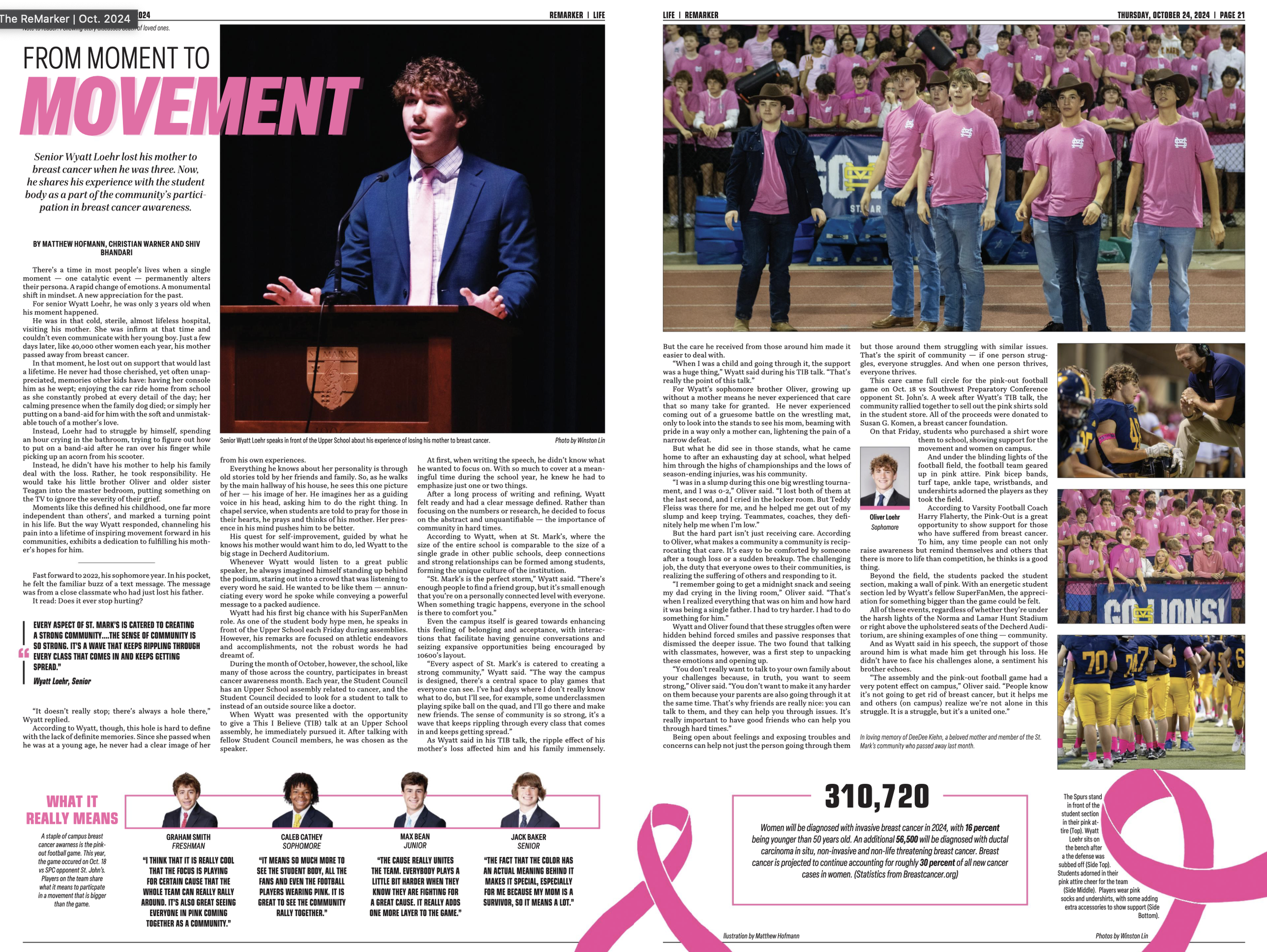
Not even tragic events can elicit care in a culture of apathy. So this detachment extends beyond ‘breaking news’ — indifference and disinterest have seeped into everyday social interactions and relationships. Uniqueness, opinion and personality seem to be absent as shrugs and nebulousness fill texts and conversations; everything feels cloaked and superficial.
And this trend has also sparked a growing wariness surrounding concerns that it could lead to serious consequences rippling through all aspects of one’s daily life. The school’s mission aims to instill character and leadership qualities contrary to the apathy now beginning to pervade youth culture.
Popularized on social media, the idea of ‘nonchalance’ has infiltrated the minds of children susceptible to short-form content. According to the Director of Marksman Wellness Center Dr. Gabriela Reed, young people are scientifically less motivated, echoing the same three words.
I don’t care.
To some, it’s an anthem for a generation that is becoming apathetic about everything.
Self-improvement trends constantly go in and out of relevance, swept aside by the next movement. Yet in every generation, the image and appeal of being ‘cool’ captures the attention of young people.
To senior Pranav Danda, the general culture of social media is responsible for much of how young people act. Idolizing fictional figures or celebrities and influencers has, in part, given rise to not caring.
“It seems like it’s cool to be detached from the world a little bit and be by yourself,” Danda said. “School might be one of those things that you don’t think is super important; it’s just another thing you detach yourself from.”
Danda notes that some students might even downplay the amount of studying they do, hoping to appear smarter. If someone doesn’t study a lot and still does well in school, others might think he is effortlessly intelligent. And if he doesn’t do well on a test, he can just blame it on the lack of studying. To this, Reed believes that this avoidance tactic, ‘perfection paralysis’, harms students’ ability to learn and be genuinely curious.
“If you don’t try your best because you waited till the last minute, then it doesn’t hit the ego as much as if you actually put all your effort in,” Reed said.
In the past, this type of behavior might have been seen in a different light, a decision to be careless and uninfluenced by social pressures.
“There’s always been the (kid) who thinks it’s cool to not care,” English teacher Cameron Hillier ‘13 said. “Fifty years ago, he was wearing a Letterman jacket and leaning on his car in the parking lot smoking a cigarette. What’s bad is if more people are believing that myth. If social media is playing into that, then that would be pouring gas on that fire.”
Another reason for the popularity of nonchalance is the focus on individuality. Since these trends are predominantly seen in young boys, being independent might seem appealing.
“Being alone might make you seem stronger,” Danda said. “You don’t ask for help or for things; everything seems like it doesn’t matter. You don’t seem like you are struggling and have everything under control. People don’t look at you differently or feel bad for you.”
But acting indifferent takes its toll on oneself. Many teenagers feel hesitant to pursue a niche and “nerdy” interest, or laugh at a joke, or be outwardly passionate about anything that might be deemed uncool. Danda has often debated joining clubs or attending school functions because of the way he would be perceived by his friends.
Reed believes this behavior is self-destructive — actively trying to be apathetic requires more thought and time than being genuine.
“It’s so ironic,” Reed said “It actually takes a lot of effort to act like you don’t care about anything.”
Social apathy has infiltrated teenage relationships, parents and romantic partners, altering how people connect with those closest to them.
“If the kids are being uncooperative, it can cause parenting problems,” Reed said. “It creates a negative dynamic within the family, and parents are supposed to be the biggest influence on their children.”
The effects go beyond familial strife. When teenagers act indifferent towards their parents and their advice, they miss out on the necessary support that helps them grow. And as a result, a cycle might form where parents become frustrated by their children’s lack of response, and then begin to pull back their own care in response.
Hillier also sees this detached attitude as harmful, especially when considering how these developments might affect young men in future relationships, sticking with them into adulthood.
“Do you want your dad’s approach to you to be ‘I don’t really care’?” Hillier said. “You want to be the type of husband who cares deeply for your spouse and children.”
In romantic relationships, acting indifferent and showing little interest has become the norm. As a result, an increasing number of teenage boys have begun to believe that openly showing excitement or care makes them appear desperate.
“There’s a stigma now that being too overinterested in a girl can be bad,” Danda said. “People think that’s how you get girls now. It’s about seeming uninterested and not caring.”
Yet this approach goes against what many women actually appreciate and desire in relationships. Reed recalls her own dating experience with her now-husband, recounting how he wrote a card for her every single day while she was away during her two-month study abroad program in Germany — an act that flew in the face of a “play it cool” mentality.
“From a female perspective, I definitely prefer someone who shows up and cares,” Reed said. “It was 20 years ago, and I still have all of those cards.”
The notably tight-knit relationships among young men can also contribute to the growing trend of exaggerated masculinity, Reed said. And at school, a place where brotherhood and togetherness are core facets of the environment, these social behaviors can be amplified.
“A lot of those guys gravitate towards each other, and then they can teach each other with their nonchalantness,” Reed said. “It’s a race to the bottom at this point — who can care less — but they all secretly really care.”
Jeremy Edge, a licensed professional counselor, has watched similar themes play out in his own office as well. From his counseling experience, he has observed how teenagers are especially susceptible to these new ideas that seem exciting or different from the status quo — progressive perspectives that just might offer new paths to maneuver through life’s labyrinth.
“If they find something like this online and it really resonates, or if there’s something that they like about the influencer or look up to their ideas, it can help them justify that that would help them reach whatever goals they might have,” Edge said.
But the very moments when young people should develop genuine connections — during the chaos of high school and college as transitional periods in life — are when they’re now most likely to stumble across content on the Internet telling them not to care at all. And without adequate guidance to really process what young people are consuming, Edge believes that it can be only natural to become influenced.
“Kids want to fit in. They want to find their footing in the world,” Edge said. “If they don’t have a support system around them, and they feel like they’re alone, it’s like they’re isolated. Then they’re going to find some kind of community elsewhere.”
At the same time, Edge also notices that parents are often in the dark about the ideological rabbit holes that their children might tumble into, with many turning a blind eye to unregulated screen time.
“I see a lot of times when parents are like, ‘Oh, they’re just online, it’s no big deal,’” Edge said. “And then when their kids get into high school or college and they start failing classes or stop socializing or not doing sports, then they see it’s an issue. But growing up as a young child, they were able to spend as much time as they wanted online without any boundaries. I think there’s ignorance, unfortunately, to some, not all parents, but some.”
However, the path forward isn’t about demonizing social media or restricting access to screens.
Edge believes the solution starts with curiosity, not immediate judgment — to explore these extreme perspectives before shutting down conversations about whatever content teenagers absorb online. To him, real change happens when people identify and grasp the underlying needs these messages promise to fulfill.
“We’re all trying to find answers to the challenges and quagmires of life,” he said. “But the better we understand what we’re reaching for and teaching ourselves, the better we can fill it in ways that help, not harm.”
Families adapt to unique circumstances
Community & identity feature
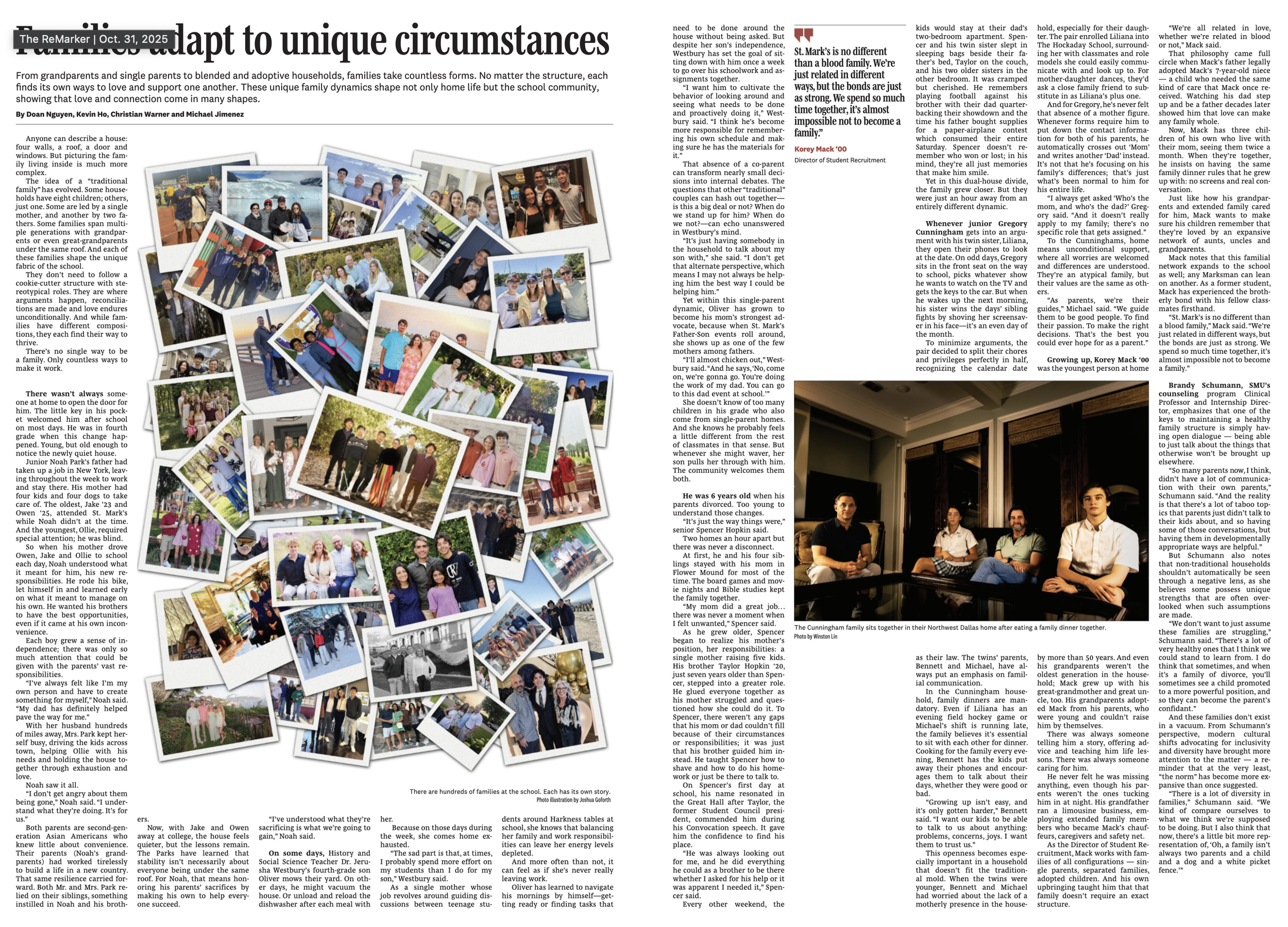
This project aimed to widen the definition of family inside our community. Schools often celebrate tradition without acknowledging how many students live outside traditional structures. I wanted the piece to reflect reality without turning anyone into a symbol.
The reporting challenge was representation. Each family’s story had to stand on its own rather than serve as an example of a trend. It took multiple interviews with sources so the feature captured daily details and intricacies instead of summaries. Visually and structurally, the collage format mirrored the argument: there is no single way to belong.
The story prompted conversations about identity and acceptance that extended beyond the page. If I revisited it now, I would expand follow-up reporting on how institutional policies affect nontraditional families. This feature taught me that inclusive journalism emphasizes giving sources the platform and space to speak fully.
Impact: Expanded representation of nontraditional families
Anyone can describe a house: four walls, a roof, a door and windows. But picturing the family living inside is much more complex.
The idea of a “nuclear family” has evolved. Some households have eight children; others, just one. Some are led by a single mother, and another by two fathers. Some families span multiple generations with grandparents or even great-grandparents under the same room. And each of these families shape the unique fabric of our school.
They don’t need to follow a cookie-cutter structure with stereotypical roles. They are where arguments happen, reconciliations are made and love endures unconditionally. And while families have different compositions, they each find their way to thrive.
There’s no single way to be a family. Only countless ways to make it work.
There wasn’t always someone at home to open the door for him. The little key in his pocket welcomed him home after school on most days. He was in fourth grade when this change happened. Young, but old enough to notice the newly quiet house.
Junior Noah Park’s father had taken up a job in New York, leaving throughout the week to work and stay there. His mother had four kids and four dogs to take care of. The oldest, Jake ’23 and Owen ‘25, attended St. Mark’s while Noah didn’t at the time. And the youngest, Ollie, required special attention; he was blind.
So when his mother drove Owen, Jake and Ollie to school each day, Noah understood what it meant for him, his new responsibilities. He rode his bike, let himself in and learned early on what it meant to manage on his own. He wanted his brothers to have the best opportunities, even if it came at his own inconvenience.
Each boy grew a sense of independence; there was only so much attention that could be given with the parent’s vast responsibilities.
“I’ve always felt like I’m my own person and have to create something for myself,” Noah said. “My dad has definitely helped pave the way for me.”
With her husband hundreds of miles away, Mrs. Park kept herself busy, driving the kids across town, helping Ollie with his needs and holding the house together through exhaustion and love.
Noah saw it all.
“I don’t get angry about them being gone,” Noah said. “I understand what they’re doing. It’s for us.”
Both parents are second-generation Asian Americans who knew little about convenience. Their parents (Noah’s grandparents) had worked tirelessly to build a life in a new country. That same resilience carried forward. Both Mr. and Mrs. Park relied on their siblings, something instilled in Noah and his brothers.
Now, with Jake and Owen away at college, the house feels quieter, but the lessons remain. The Parks have learned that stability isn’t necessarily about everyone being under the same roof. For Noah, that means honoring his parents’ sacrifices by making his own to help everyone succeed.
“I’ve understood what they’re sacrificing is what we’re going to gain,” Noah said.
On some days, History and Social Science Teacher Dr. Jerusha Westbury’s fourth-grade son Oliver mows their yard. On other days, he might vacuum the house. Or unload and reload the dishwasher after each meal with her.
Because on those days during the week, she comes home exhausted.
“The sad part is that, at times, I probably spend more effort on my students than I do for my son,” Westbury said.
As a single mother whose job revolves around guiding discussions between teenage students around Harkness tables at school, she knows that balancing her family and work responsibilities can leave her patience levels depleted.
And more often than not, it can feel as if she’s never really leaving work.
Oliver has learned to navigate his mornings by himself—getting ready or finding tasks that need to be done around the house without being asked. But despite her son’s independence, Westbury has set the goal of sitting down with him once a week to go over his schoolwork and assignments together.
“I want him to cultivate the behavior of looking around and seeing what needs to be done and proactively doing it,” Westbury said. “I think he’s become more responsible for remembering his own schedule and making sure he has the materials for it. But that also means that sometimes, I’m missing when he needs extra assistance.”
That absence of a co-parent can transform nearly small decisions into internal debates. The questions that other “traditional” couples can hash out together—is this a big deal or not? When do we stand up for him? When do we not?—can echo unanswered in Westbury’s mind.
“It’s just having somebody in the household to talk about my son with,” she said. “I don’t get that alternate perspective, which means I may not always be helping him the best way I could be helping him.”
Yet within this single-parent dynamic, Oliver has grown to become his mom’s strongest advocate, because when St. Mark’s Father-Son events roll around, she shows up as one of the few mothers among fathers.
“I’ll almost chicken out,” Westbury said. “And he says, ‘No, come on, we’re gonna go. You’re doing the work of my dad. You can go to this dad event at school.’”
She doesn’t know of too many children in his grade who also come from single-parent homes. And she knows he probably feels a little different from the rest of classmates in that sense. But whenever she might waver, her son pulls her through with him. The community welcomes them both.
He was 6 years old when his parents divorced. Too young to understand those changes.
“It’s just the way things were,” Senior Spencer Hopkin said.
Two homes an hour apart but there was never a disconnect.
At first, he and his four siblings stayed with his mom in Flower Mound for most of the time. The board games and movie nights and bible studies kept the family together.
“My mom did a great job… there was never a moment when I felt unwanted,” Spencer said.
As he grew older, Spencer began to realize his mother’s position, her responsibilities: a single mother raising 5 kids. His brother Taylor Hopkin ‘20, just seven years older than Spencer, stepped into a greater role. He glued everyone together as his mother struggled and questioned how she could do it. To Spencer, there weren’t any gaps that his mom or dad couldn’t fill because of their circumstances or responsibilities; it was just that his brother guided him instead. He taught Spencer how to shave and how to do his homework or just be there to talk to.
On Spencer’s first day at school, his name resonated in the Great Hall after Taylor, the former Student Council president, commended him during his Convocation speech. It gave him the confidence to find his place.
“He was always looking out for me, and he did everything he could as a brother to be there whether I asked for his help or it was apparent I needed it,” Spencer said.
Every other weekend, the kids would stay at their dad’s two-bedroom apartment. Spencer and his twin sister slept in sleeping bags beside their father’s bed, Taylor on the couch, and his two older sisters in the other bedroom. It was cramped but cherished. He remembers playing football against his brother with their dad quarterbacking their showdown and the time his father bought supplies for a paper-airplane contest which consumed their entire Saturday. Spencer doesn’t remember who won or lost; in his mind, they’re all just memories that make him smile.
Yet in this dual-house divide, the family grew closer. But they were just an hour away from an entirely different dynamic.
Whenever junior Gregory Cunningham gets into an argument with his twin sister, Liliana, they open their phones to look at the date. On odd days, Gregory sits in the front seat on the way to school, picks whatever show he wants to watch on the TV and gets the keys to the car. But when he wakes up the next morning, his sister wins the days’ sibling fights by shoving her screensaver in his face—it’s an even day of the month.
To minimize arguments, the pair decided to split their chores and privileges perfectly in half, recognizing the calendar date as their law. The twins’ parents, Bennett and Michael, have always put an emphasis on familial communication.
In the Cunningham household, family dinners are mandatory. Even if Liliana has an evening field hockey game or Michael’s shift is running late, the family believes it’s essential to sit with each other for dinner. Cooking for the family every evening, Bennett has the kids put away their phones and encourages them to talk about their days, whether they were good or bad.
“Growing up isn’t easy, and it’s only gotten harder,” Bennett said. “I want our kids to be able to talk to us about anything: problems, concerns, joys. I want them to trust us.”
This openness becomes especially important in a household that doesn't fit the traditional mold. When the twins were younger, Bennett and Michael had worried about the lack of a motherly presence in the household, especially for their daughter. The pair enrolled Liliana into The Hockaday School, surrounding her with classmates and role models she could easily communicate with and look up to. For mother-daughter dances, they’d ask a close family friend to substitute in as Liliana’s plus one.
And for Gregory, he’s never felt that absence of a mother figure. Whenever forms require him to put down the contact information for both of his parents, he automatically crosses out ‘Mom’ and writes another ‘Dad’ instead. It’s not that he’s focusing on his family’s differences; that’s just what’s been normal to him for his entire life.
“I always get asked ‘Who’s the mom, and who’s the dad?’ Gregory said. “And it doesn’t really apply to my family; there’s no specific role that gets assigned.”
To the Cunninghams, home means unconditional support, where all worries are welcomed and differences are understood. They’re an atypical family, but their values are the same as others.
“As parents, we’re their guides,” Michael said. “We guide them to be good people. To find their passion. To make the right decisions. That’s the best you could ever hope for as a parent.”
Growing up, Korey Mack ‘00 was the youngest person at home by more than 50 years. And even his grandparents weren’t the oldest generation in the household; Mack grew up with his great-grandmother and great uncle, too. His grandparents adopted Mack from his parents, who were young and couldn’t raise him by themselves.
There was always someone telling him a story, offering advice and teaching him life lessons. There was always someone caring for him.
He never felt he was missing anything, even though his parents weren’t the ones tucking him in at night. His grandfather ran a limousine business, employing extended family members who became Mack’s chauffeurs, caregivers and safety net.
As the Director of Student Recruitment, Mack works with families of all configurations — single parents, separated families, adopted children. And his own upbringing taught him that that family doesn’t require an exact structure.
“We’re all related in love, whether we’re related in blood or not,” Mack said.
That philosophy came full circle when Mack’s father legally adopted Mack’s seven-year-old niece — a child who needed the same kind of care that Mack once received. Watching his dad step up and be a father decades later showed him that love can make any family whole.
Now, Mack has three children of his own who live with their mom, seeing them twice a month. When they’re together, he insists on having the same family dinner rules that he grew up with: no screens and real conversation.
Just like how his grandparents and extended family cared for him, Mack wants to make sure his children remember that they’re loved by an expansive network of aunts, uncles and grandparents.
Mack notes that this familial network expands to the school as well; any Marksman can lean on another. As a former student, Mack has experienced the brotherly bond with his fellow classmates firsthand.
“St. Mark’s is no different than a blood family,” Mack said. “We’re just related in different ways, but the bonds are just as strong. We spend so much time together, it’s almost impossible not to become a family.”
Brandy Schumann, SMU’s counseling program Clinical Professor and Internship Director, emphasizes that one of the keys to maintaining a healthy family structure is simply having open dialogue — being able to just talk about the things that otherwise won’t be brought up elsewhere.
“So many parents now, I think, didn't have a lot of communication with their own parents,” Schumann said. “And the reality is that there’s a lot of taboo topics that parents just didn't talk to their kids about, and so having some of those conversations, but having them in developmentally appropriate ways are helpful.”
But Schumann also notes that non-traditional households shouldn’t automatically be seen through a negative lens, as she believes some possess unique strengths that are often overlooked when such assumptions are made.
“We don’t want to just assume these families are struggling,” Schumann said. “There’s a lot of very healthy ones that I think we could stand to learn from. I do think that sometimes, and when it’s a family of divorce, you’ll sometimes see a child promoted to a more powerful position, and so they can become the parent’s confidant.”
And these families don’t exist in a vacuum. From Schumann’s perspective, modern cultural shifts advocating for inclusivity and diversity have brought more attention to the matter — a reminder that at the very least, “the norm” has become more expansive than once suggested.
“There is a lot of diversity in families,” Schumann said. “We kind of compare ourselves to what we think we’re supposed to be doing. But I also think that now, there’s a little bit more representation of, ‘Oh, a family isn’t always two parents and a child and a dog and a white picket fence.’”
Further Details: